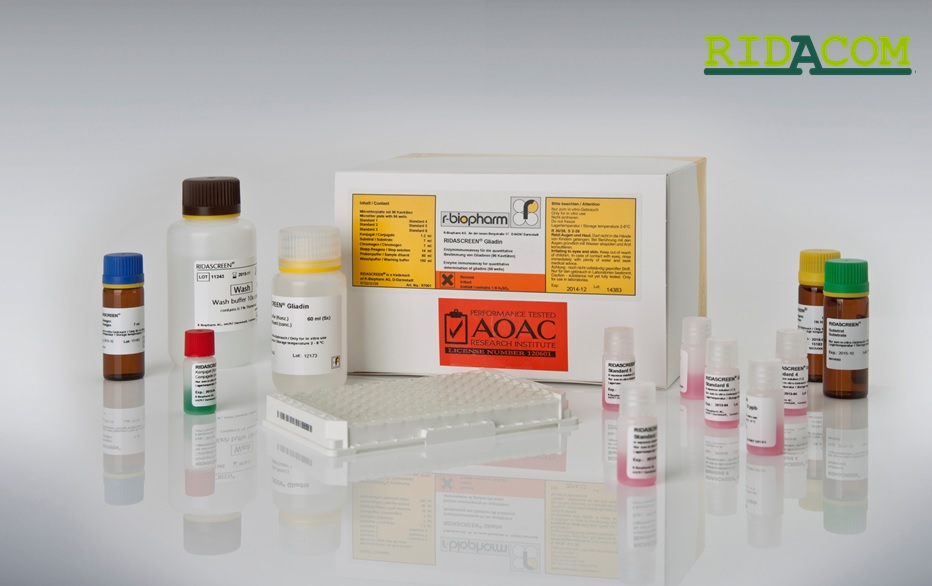
RIDASCREEN®FAST Casein is a sandwich enzyme immunoassay for the quantitative analysis of casein in food like ice cream, wine, chocolate, beverages, infant formula, bakery goods, sausages, cake and bread mix.
All reagents required for the enzyme immunoassay - including standards - are contained in the test kit.
For in vitro use only.
General Information:
Cow`s milk contains 3.2% proteins which consist of 10% ß-lactoglobulin (leading protein of whey) and 80% caseins. The most important allergen is ß-lactoglobulin especially for children while the caseins become to be dominant later in adults. Casein (lat. Caseus = cheese) is a rough flaked curdling protein, which forms micells in the milk and precipitates under acidic conditions.
The allergen can be present as an ingredient or as a contamination in raw and cooked products. According to the Regulation (EU) No. 1169/2011 milk and products thereof must be declared on food labels. Similar regulations exist e.g. in the USA, Canada, Australia and New Zealand.
Milk as an allergy trigger
More and more people suffer from milk allergies. It is important to note that milk allergy is not the same as lactose intolerance. The cause of lactose intolerance is a deficiency of an enzyme that degrades lactose (milk sugar). Milk allergy, on the other hand, is a true food allergy which is caused by allergenic constituents of milk proteins. Cow’s milk contains several proteins that have an allergic potential. The most important ones are casein and ß-lactoglobulin.
Casein
One of the major allergens in milk is casein. It plays an important role in cheese production and is mainly present in cheese, quark, yoghurt, cream and butter. Moreover, casein is present in bakery goods, chocolate, wine and meat products. Since the protein casein is not specific for cow’s milk, it is also present in sheep’s milk, goat milk and other types of milk.
ß-lactoglobulin
ß-lactoglobulin is a whey protein. It is present in fresh milk and in hydrolysed dairy products such as baby food. The allergy to ß-lactoglobulin usually occurs in children, while adults are more often allergic to casein. Since ß-lactoglobulin is not heat-stable, allergic people often tolerate cooked dairy products. In addition, products made from sheep or goat milk can be well tolerated.
As an allergen, milk is subject to labelling in many countries. In order to ensure a product that is safe for milk allergic people, it is important to test food and surfaces for milk protein during the production process.
Test Format: Microtiter plate with 48 wells (6 strips with 8 removable wells each)
Standard Range: 0 mg/kg (zero standard), 0.5 mg/kg, 1.5 mg/kg, 4.5 mg/kg, 13.5 mg/kg casein
Sample Preparation: homogenization, extraction and centrifugation
Incubation Time: 30 min
Detection Limit:
- Limit of detection:
Allergen extraction buffer: 0.12 mg/kg (ppm) casein
RIDA® Extractor 2: 0.71 mg/kg (ppm) casein - Limit of quantification:
Allergen extraction buffer: 0.5 mg/kg (ppm) casein
RIDA® Extractor 2: 2.5 mg/kg (ppm) casein
Cross-reactivity: There is no cross-reactivity to ß-lactoglobulin.
Specificity: The antibodies specifically detect caseins of cow’s milk and caseins of sheep’s, goat’s and buffalo’s milk.
YouTube - Allergen Analysis Test Procedure for the Sandwich ELISA RIDASCREEN®FAST