General information about this test:
NADAL® Legionella/S. pneumonia Test is a rapid chromatographic immunoassay for qualitative detection of Streptococcus pneumoniae and Legionella pneumophila in urine samples with no need of dilution. NADAL® Legionella/S. pneumonia Test is aimed to aid diagnosis of Legionnaires’ disease, pneumonia, otitis media and meningitis and is intended for professional use only.
Reagents and material supplied:
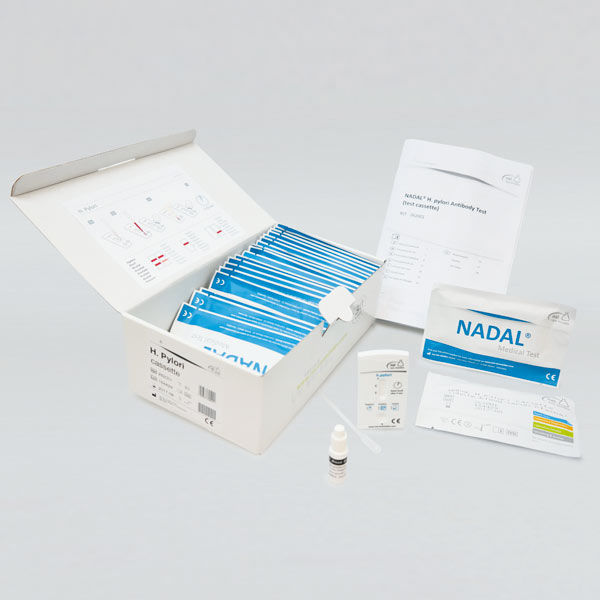
- 10 NADAL® Legionella/S. pneumoniae test cassettes (incl. disposable pipettes)
- 1 package insert
Test time: 10 min
Performance characteristics:
- Legionella pneumophila
The data about the cross-reactivity of the NADAL® Legionella/S. pneumonia Test with microorganisms belonging to genus Legionella were obtained by testing cultures with concentration 1 x 10⁸ CFU/ml. NADAL® Legionella/S. pneumonia Test displays no cross-reactivity with the following microorganisms from genus Legionella: Legionella pneumophila serogroup 2-14, Legionella anisa, Legionella bozemanii, Legionella dumofii, Legionella feeleii, Legionella gormanii, Legionella hackeliae, Legionella micdadei, Legionella longbeachae.
No cross-reactivity was observed with cultures of the following microorganisms (3 x 10⁸ CFU/ml): Bacillus subtilis, Enterococcus faecalis, Enterococcus faecium, Micrococcus luteus, Staphylococcus aureus, Staphylococcus epidermidis, Streptococcus faecalis, Streptococcus mutans, Streptococcus pneumoniae, Streptococcus pyogenes, Streptococcus sanguis, Acinetobacter baumanii, Branhamella catarrhalis Enterobacter cloacae, Escherichia coli, Haemophilus influenzae, Klebsiella oxytoca, Klebsiella pneumoniae, Proteus mirabilis, Proteus valugaris, Pseudomonas seruginosa, Salmonella enteritidis, Salmonella paratyphi А,Salmonella typhi, Serratia marcescens, Candida albicans, Candida glabrata and Candida tropicali.
Diagnostic sensitivity and specificity ofthe NADAL® Legionella/S. pneumoniae Test regarding Legionella pneumophila were determined by comparative analysis with another rapid immunoassay - BinaxNOW® Legionella.
Sensitivity: 100%
Specificity: 100%
Overall agreement: 100%
Intra-assay reproducibility: 100%
- Streptococcus pneumoniae
The NADAL® Legionella/S. pneumoniae Test shows no non-specific reactions with the following microorganisms: Strep A, B, C, D, E, F, G & H, Staphylococcus Aureus, Bacillus subtitilis. Positive result for cross-reactivity with Streptococcus Pneumoniae capsulartypes (8) was observed.
The diagnostic specificity and sensitivity of NADAL® Streptococcus Pneumoniae Test were confirmed by comparison with another rapid immunoassay – BinaxNOW® Streptococcus pneumonia.
Sensitivity: 79%
Specificity: 84%
Overall agreement: 81%
Intra-assay reproducibility: 100%
Test principles:
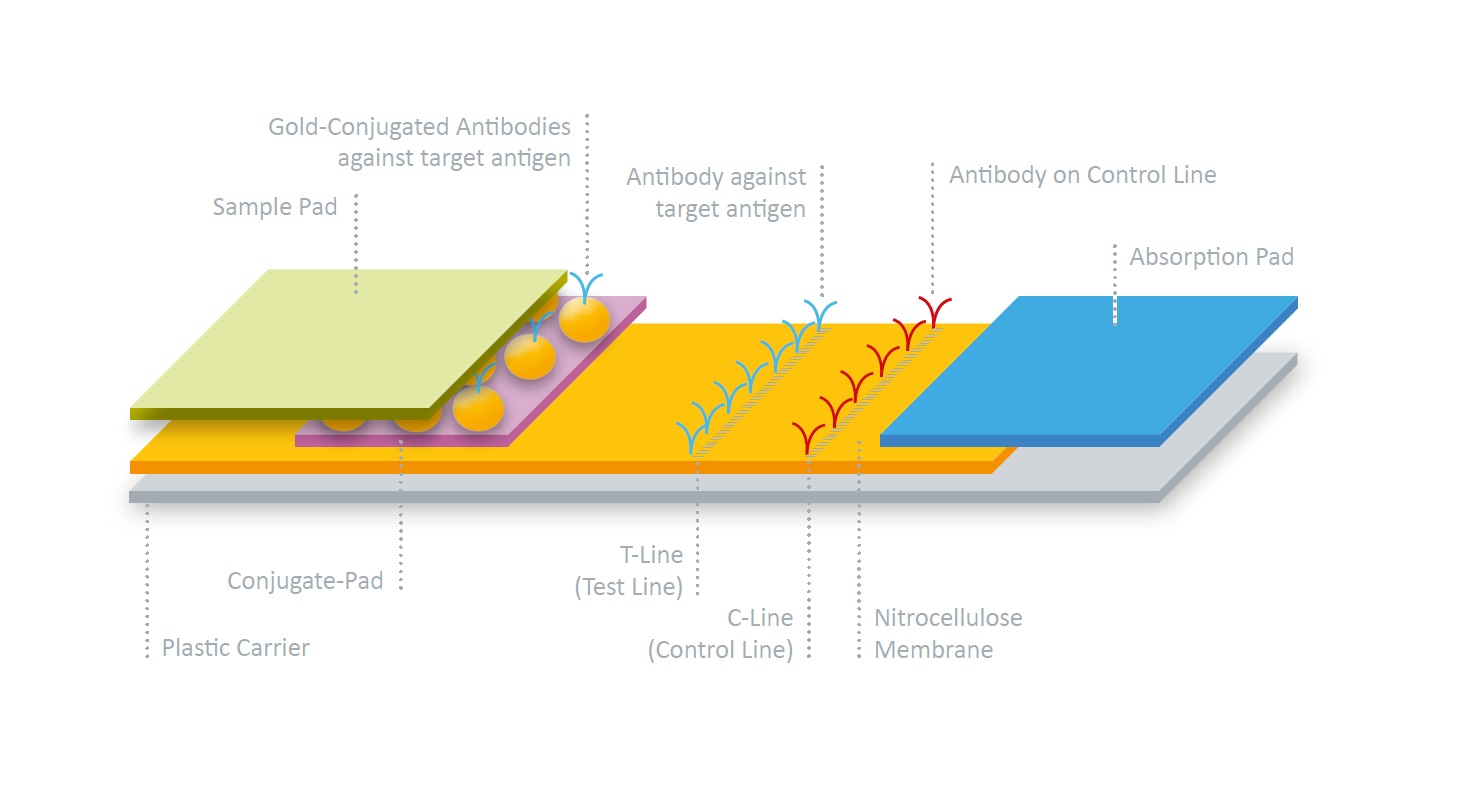
The NADAL® Legionella/S. pneumoniae Test is a qualitative lateral flow immunoassay for the detection of S. pneumoniae and L. pneumophila antigens in urine samples. The NADAL® Legionella/S. pneumoniae test-cassette houses two test strips for detection of S. pneumoniae and L. pneumophila respectively. Few drops of urine should be added to each sample well of the test-cassette. S. pneumonia- and/or L. pneumophila-antigens eventually present in the sample first bind to labelled antibody-dye conjugate. Further the antigen-antibody complexes move along the test strip by capillary action and eventually bind to polyclonal Legionella/ Streptococcus antibodies at the test (T) line of the assay thus producing a rose-pink line. A rose-pink line should always appear in the control line region (C) and serves as a procedural control, indicating that the proper volume of specimen has been added and membrane wicking has occurred.
Clinical significance:
Legionella pneumophila is a gram-negative non-spore forming aerobic bacterium widely spread in the environment. L.pneumophila infects upper respiratory tract. Legionellosis occurs in two forms: Legionnaires’ disease (atypical severe pneumonia) and Pontiac fever (with flu-like symptoms). Spreading of the bacterium by the bloodstream or the lymph system causes development of extrapulmonary infection affecting the heart, brain, kidney, liver and/or spleen. Estimated 10 000 and 25 000 Legionella infections occur in the United States annually. Case-fatality of Leginnaires’ disease may be as high as 30%.
Streptococcus pneumoniae is a gram-positive lancet-shaped anaerobic bacterium first isolated from the saliva of a patient with rabies by Pasteur in 1881. The chemical structure and antigenicity of the pneumococcal capsular polysaccharide and its association with virulence and its role in human disease were thoroughly examined in the beginning of the XXth century. The bacteria are spread by direct person-to-person contact via respiratory droplets. The 10 most common serotypes are estimated to cause about 62% of invasive disease worldwide. S. pneumoniae infects upper respiratory tract tissues causing severe pneumonia and mild to acute earache/ otitis. Bacterial pneumonia accounts for 12-16% of invasive pneumococcal disease among children aged 2 years and younger.
Pneumococci cause 13% to 19% of all cases of bacterial meningitis in the United States. One-fourth of patients with pneumococcal meningitis also have pneumonia. Clinical symptoms of this meningitis type are generally similar to those of other forms of purulent bacterial meningitis and include headache, lethargy, vomiting, irritability, fever, nuchal rigidity, cranial signs, seizures and coma. The mortality rate of meningitis caused by pneumococci is about 30% but can reach 80% for elderly patients. S. pneumoniae is the main cause of bacterial meningitis among children younger than 5 years of age in the United States.
Antibiotic treatment is efficient even against penicillin-resistant strains. Several vaccines are available with variable efficiency depending on patient age or whether patients are developing some chronic illness or immunodeficiency.