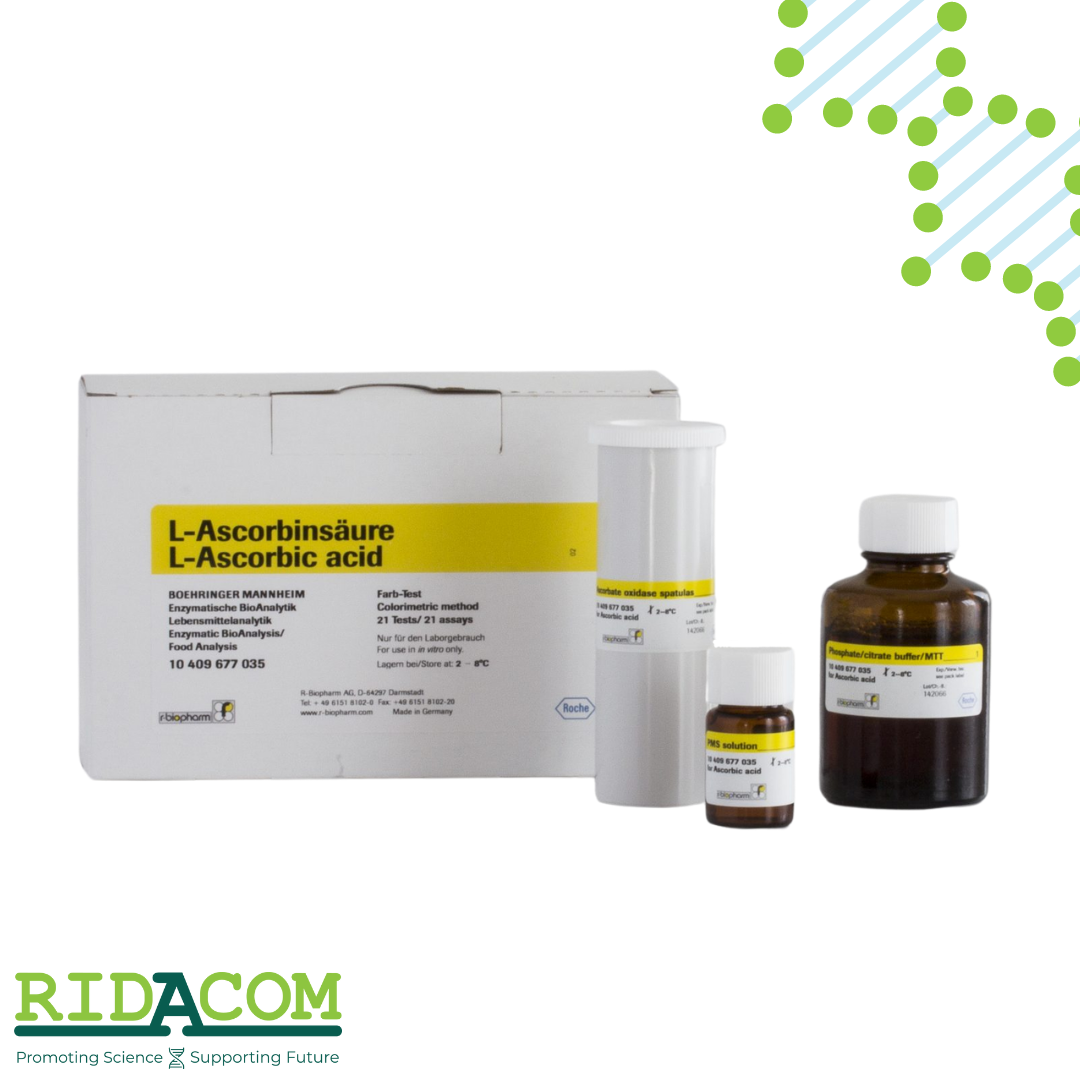
L-Ascorbic Acid is an enzymatic test for the determination of L-ascorbic acid in foodstuffs and other materials, through a colorimetric method. Determination of iso-ascorbic acid.
For in vitro use only.
General Information:
L-ascorbic acid (vitamin C) is a naturally occurring organic compound with antioxidant properties and is found ubiquitously in fruit and vegetables. Its quantitative determination is especially important in the production of wine, beer, milk, soft drinks and fruit juices, where it can be a quality indicator. Given the essential role in human diet, L-ascorbic acid (E300) and salt derivatives (E301-303) are commonly used as food additives, with the additional advantage of their antioxidant and flavor enhancing properties. In wine industry, L-ascorbic acid can be added to prevent oxidation of wine. In beer production, L-ascorbic acid and its salts are efficient anti-oxidants and have a positive influence on aroma, taste and stability. In the meat industry, L-ascorbic acid is used as a reddening agent and as an anti-oxidant. L-ascorbic acid is also used in the pharmaceutical industry and as additive in animal feed. If L-ascorbic acid is added in food production, the content must be controlled.
Test Format: Test combination for 21 determinations
Wavelength: 578 nm
Temperature: 37 °C
Sample Solution: 0.5-20 μg L-ascorbic acid per assay (in 0.100-1.600 mL sample volume)
| LOD (Detection limit): 0.3 mg / L |
|---|